
Welcome to Chalkbeat Ideas, a new section featuring reported columns on the big ideas and debates shaping American schools. Forwarded this newsletter? Sign up here.
Children from low-income families have roughly $80,000 less invested in their development, well-being, and education relative to their peers from high-income households, according to a new study.
The research is significant because it puts a figure on what has long been known: Children do not have the same access to the resources that might help them flourish. While formal schooling is fairly equal, investments outside of school vary substantially, the researchers conclude.
“The findings of this are not surprising,” says David Blazar, the study’s lead author and a professor at the University of Maryland. “What’s most compelling is thinking about investments in kids as a bundle — it’s not just about housing, it’s not just about early childhood. It’s about the investments we make altogether.”
At a moment when there is intense discussion about declines and disparities in student learning, the study is a helpful reminder of the broad array of factors that shapes children’s academic success.
The paper, written by several researchers and published last month, examines “childhood human capital investments” — in other words, the various resources that help children thrive and develop.
This is defined broadly to include formal schooling, as well as informal education, nutrition, health care, and housing, among other things. The researchers rely on a number of recent national surveys and put every item on a common dollar scale, including things that are not paid for, like parental time helping with homework or going to the library.
Under the researchers’ measure, the typical child received about half a million dollars’ worth of investment in their development through childhood. The disparities were significant, though. In addition to gaps by family income, there were also racial gaps. Relative to white kids, Hispanic kids had $73,000, or 14%, less investment. Black children had $55,000, or 10%, less.
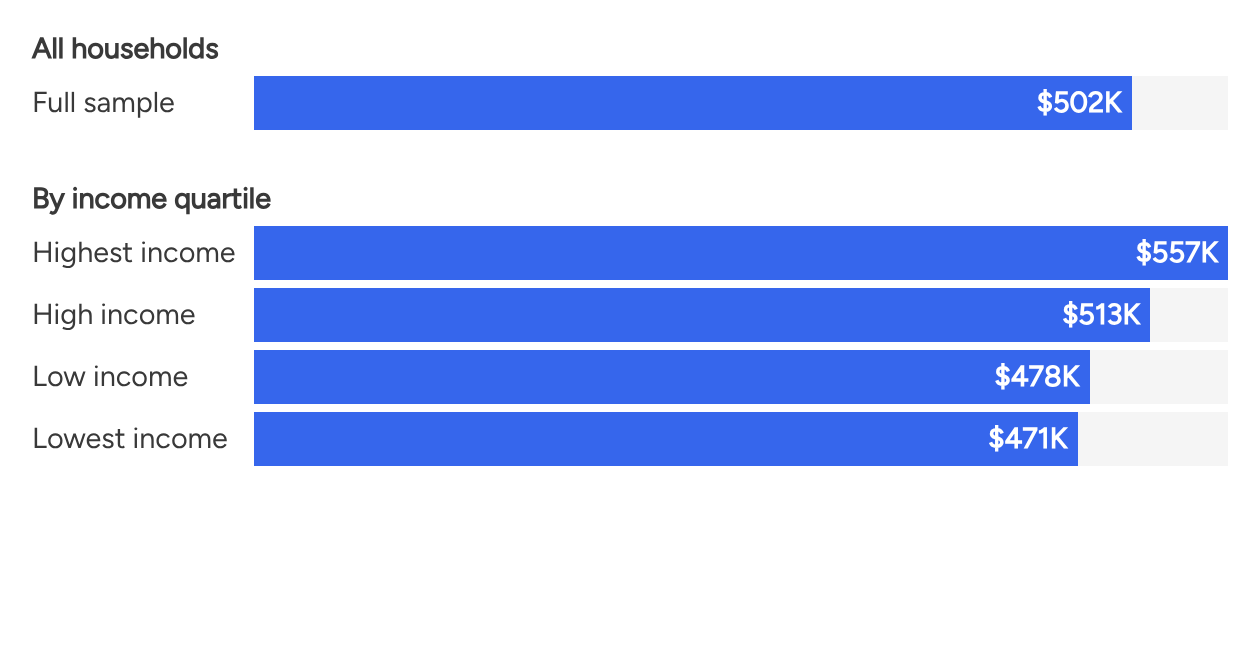
The researchers also considered time as a form of investment. They converted parental activities into a standard hourly dollar rate. Here there were also some gaps by income and race, though they were not especially large. Low-income children were slightly less likely to be read to or taken to a museum, but were more likely to get homework help or visit a zoo. This indicates that parents of all types put large amounts of time into their children’s development.
The overall disparities would likely be far larger without government programs designed to equalize opportunity, the researchers say. Investments in formal schooling, largely through public education, were fairly equal. This echoes analyses showing that there are typically not large gaps in spending between high-poverty and affluent schools. If anything, children in poverty had a bit more money spent on their education, the recent study finds.
“We see that the sectors where the disparities are smallest are when government services are the largest,” says Blazar.
His study does not speak to whether particular investments are effective in helping children develop, but in some cases other research does. For instance, low-income children are more likely to be identified for special education; these services lead to large gains in learning, according to a recent study. Research has also found that certain anti-poverty programs can boost test scores.
The latest study likely underestimates gaps in resources between different groups of students, Blazar says. Because of data limitations, the paper does not attempt to parse the quality of school a child attends, the doctor they go to, or the food they eat. The researchers also do not consider the neighborhood a child lives in or whether they’ve been exposed to environmental hazards. Both of these factors have been linked to success in school.
And while the paper includes the striking finding that formal education investments are relatively equal, the study stops at age 18. If the study continued a few more years, though, the findings would almost certainly be different. Children from low-income families are less likely to go to college and if they do, they typically attend less well-resourced schools.
So while K-12 educational investments have been equalized to a meaningful extent, vast disparities emerge after high school.
Reach me at [email protected].
Thumbnail image by Rachel Woolf for Chalkbeat