Welcome to Chalkbeat Ideas, a new section featuring reported columns on the big ideas and debates shaping American schools. This is our monthly(ish) roundup of interesting takes, tidbits, and links. Forwarded this newsletter? Sign up here.
Nearly $200 billion in federal COVID relief money left schools in a relatively strong financial position in recent years. But new data highlights a potential unintended consequence of all the federal aid: states cutting back on their own efforts to fund education.
A report, released by the Albert Shanker Institute, a think tank affiliated with the American Federation of Teachers, tracks the share of each state’s economy devoted to public schools. Researchers call this “fiscal effort.” I like to think about it as the tax rate applied to the states’ economy to fund education (though it’s really multiple taxes). Crucially, this does not count federal dollars, just state and local money.
By this measure, funding effort dropped sharply between 2020 and 2023, as the figure below from the report shows. This doesn’t mean that states are spending less in real dollars on schools because the economy has also been growing during this time. They’re spending less as a percentage of the economy.
The decline in effort could have happened because states felt less pressure to fund education themselves since the federal government poured in so much money. This is just a hypothesis, though report author Bruce Baker tells me it’s a reasonable one.
If the federal COVID money crowded out state funding, that suggests it was not quite as large a boon to school budgets as it initially seemed. This is worth keeping in mind the next time there’s discussion of putting a lot more federal dollars into education.
The other key point is that states may have more economic capacity to increase funding for schools — if politicians want to. This is all the more reason why the recent rise in school staffing is not inherently unsustainable, as I recently wrote.
The COVID money is now essentially gone so the question is how states are responding. We don’t have the data yet to fully understand how this is playing out nationally. Baker says in preliminary analysis he sees a bounce back in state effort in 2024.

Event: Is a college degree worth it?
Join us on Monday for the next Chalkbeat Ideas event, about the myths and realities of American higher education. I’m excited to walk through what the data really shows about college tuition, enrollment, and payoff. We’ll then have a rich conversation with KIPP Foundation CEO Shavar Jeffries and Princeton economist Zachary Bleemer. Sign up here to attend.
Parents, teachers, students: What do you think of homework?
Please tell me by filling out this survey. This will inform a reporting project that I’m in the midst of about how teachers are using homework, how that’s changed in recent years, and what the benefits and downsides of homework are.
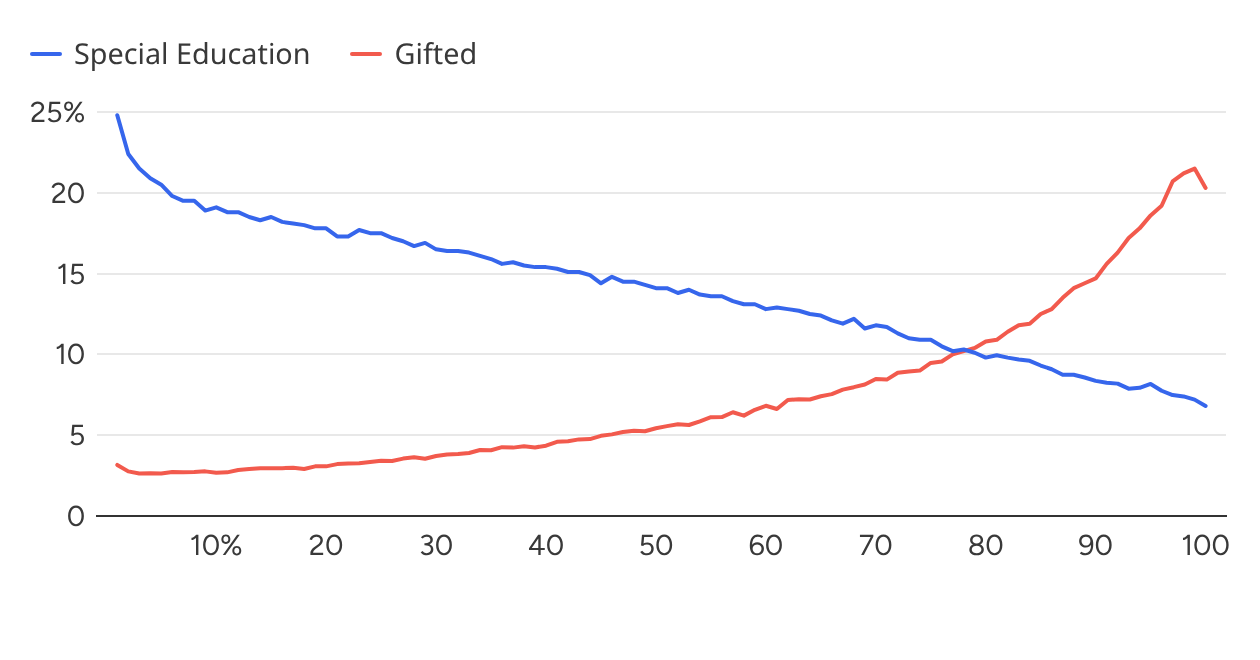
Who gets identified as gifted and who gets special education?
In two recent papers, a team of researchers used detailed data from Oregon to look at the relationship between family income and students' chances of being identified as gifted and as having a disability.
The results were striking, as shown below. There’s a strong positive relationship between income and gifted identification, which is reversed when looking at special education. I don’t have a snappy takeaway from this big-picture data, but the causes and consequences are worth pondering.
AI-powered cheating remains rampant in schools.
Most teens say peers cheat using artificial intelligence at least “somewhat often,” according to a recent Pew poll. Teachers have discussed this regularly since AI hit the mainstream. This challenge does not seem to be going away.

The effect of teachers’ strikes
Following San Francisco's teachers strike and the threat of others in California, it’s worth taking a look at a comprehensive recent study on strikes. It found that teacher strikes don’t typically help or harm student achievement much. The notable exception was very long strikes, lasting 10 or more days. Those did cause short-term drops in math scores. Overall, strikes were successful in getting teachers higher pay.
Time in school varies widely by state
Following a snow day and a remote learning day, the amount of time New York City students get in class has drawn attention. Chalkbeat’s Amy Zimmer reports that city students get 130 fewer hours of instruction than the national average. Advocates are also looking at this in Oregon, which has an unusually short school year. Perhaps not surprisingly, there’s good evidence that extra time helps students learn more.
What’s behind schools with 0% of students proficient?
A recent Wall Street Journal column noted that dozens of schools in Chicago had not a single student score proficient in math in 2024. How could that be? I was curious so I looked at the underlying list of schools. A large share were small charter high schools, some of which have a particular mission of serving struggling students. One charter network, which had a number of schools on the list, describes itself as catering to “youth ages 16–21 who have faced challenges in traditional school settings.” It’s concerning when student achievement is very low at any school, but some context is needed to understand these figures.
Across Chalkbeat
A small town in southeast Colorado was once home to a Japanese internment camp. These days local high school students have taken on the task of describing that dark history at a small independent museum they maintain and run. Their mission has taken on new importance as the National Park Service, which controls the camp site itself, faces pressure to tell a more positive version of American history, writes Chalkbeat’s Erica Meltzer.
A number of red states are moving to take over local schools in blue cities, reports Chalkbeat Lily Altavena. “Officials’ rhetoric to justify the tactic has become more overtly political as the country’s political divides have deepened,” she writes.
Can states create “guardrails” if they opt into the federal school choice tax credit? Some Colorado lawmakers are considering a bill to prohibit participating schools from discriminating against LGBTQ students.
In case you missed it from Chalkbeat Ideas
The Trump administration says it’s returning education to the states — yet it’s continuing to wield federal power aggressively.
Great teachers become merely pretty good when they move into low-performing schools, concludes a recent study.
As publicly funded private school choice programs grow, it will be hard to know if they’re working. There’s also no agreement on what “working” even means.
Reach me at [email protected]
Thumbnail image by Allison Shelley
Looking for your next read? Check out these other great newsletters.